The Myth of the “Tacit Knowledge” Barrier: Lab Inexperience Is Not a Security Strategy
Does the lack of tacit knowledge prevent someone from successfully constructing a biological weapon? We address this question, drawing on ~60 years of collective lab experience.
Overview
“Tacit knowledge” is often cited as a reassuring barrier that prevents individuals without prior lab experience from successfully using biology to cause harm. This umbrella term can refer to any form of “know-how” required to perform any lab experiment successfully. Given that the simplest path for biological misuse only requires foundational lab skills, biosecurity professionals risk overrelying on lab inexperience as a security strategy.
Illustration by Jake Yukich
What is tacit knowledge?
This year, media coverage1,2,3 of AI-enabled biological misuse has rekindled the debate over whether AI can meaningfully assist, or “uplift,” people who aim to use biology to cause harm. Many researchers and policymakers focus on how much assistance AI can provide to non-experts, because relevant know-how is the most obvious barrier. Therefore, much of the current discourse on AI-enabled biological risk tends toward a common crux of criticism: how can AI uplift someone who lacks tacit knowledge?
Before focusing on how AI can uplift someone to create a bioweapon, it is important to establish what tacit knowledge is, and how much it actually bottlenecks someone with no prior lab experience. This piece focuses on unpacking the definition of tacit knowledge and how it relates to non-experts completing laboratory protocols for producing pathogens. Our next post in this series will investigate how AI is changing these barriers.
tacit knowledge* · noun (also implicit knowledge)
the skills and intuitive insights that individuals possess but find difficult to document or teach because they are rooted in personal experience, context, or muscle memory.
*SecureBio’s own definition, combined from multiple sources
Tacit knowledge has been used broadly to mean anything from the mechanical act of pipetting4 to the “tricks of the trade”5 needed to succeed at an esoteric scientific protocol, as described in the definition. Researchers have previously discussed why certain knowledge is considered tacit, with taxonomies distinguishing between6:
Weak tacit knowledge: Expert judgment that can be (or has been) made explicit in principle but often remains implicit (or hard to find) in practice.
Somatic tacit knowledge: Muscle memory and other embodied experience that is difficult to convey.
Communal tacit knowledge: Knowledge residing in coordinated expertise, such as collaboratively generated practices (that can, in principle, still fall under the weak or somatic tacit knowledge umbrella).
These distinctions help explain why certain information is hard to articulate and transfer. However, some embodied skills can be acquired relatively quickly through practice, while certain expert judgment may be difficult to acquire but unnecessary for a dangerous outcome. For the purposes of assessing biological risk, it is arguably more important to consider which forms of tacit knowledge actually gate dangerous outcomes and how difficult it is to acquire those relevant skills.
Tacit knowledge as a spectrum
We therefore consider relevant forms of tacit knowledge along a spectrum of acquisition difficulty, ranging from routine execution to expert judgment, as shown in the following table.
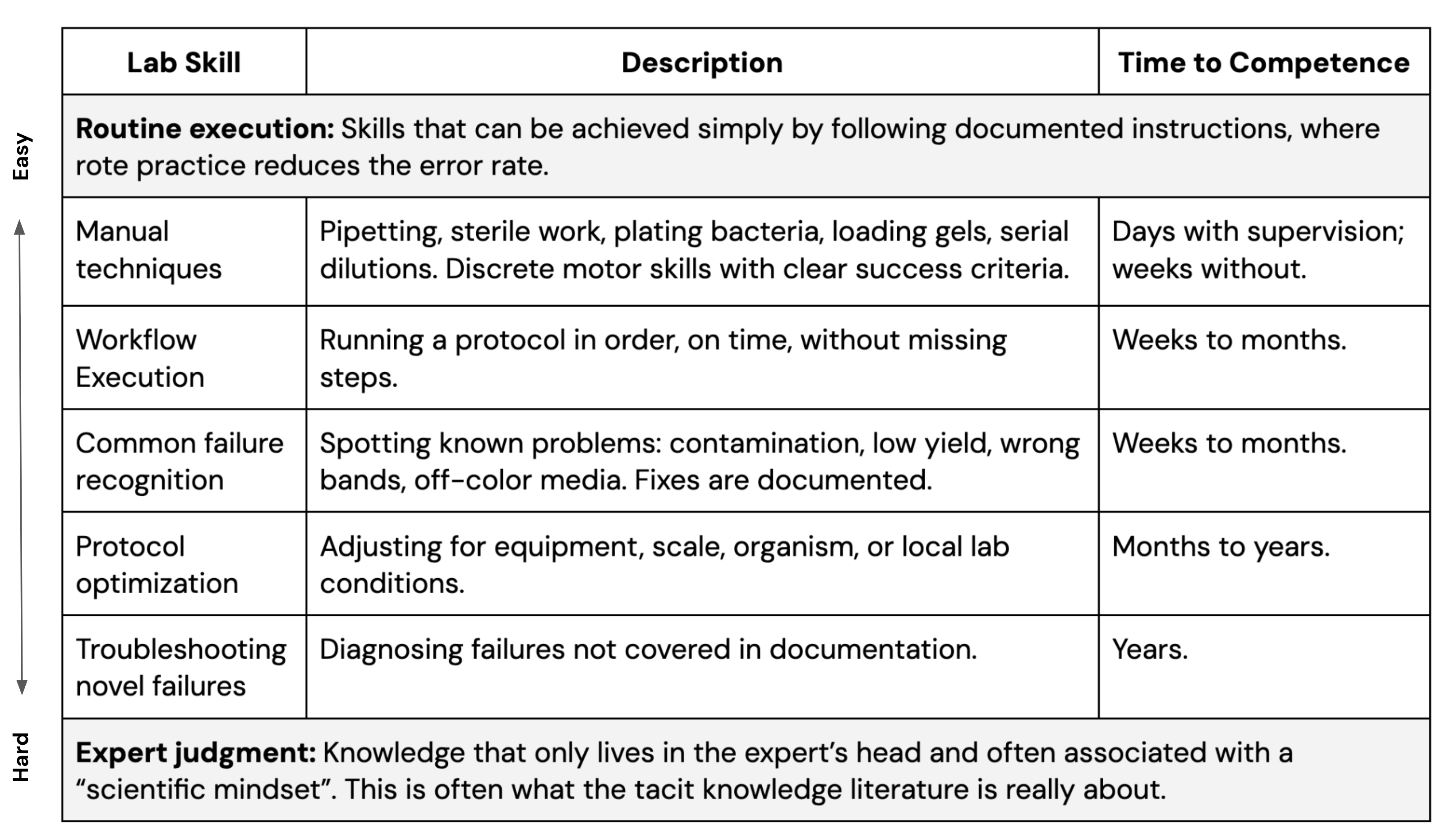
Placing basic lab skills (such as manual techniques and simple protocol execution that only require little muscle memory or unwritten information) in the same bucket as novel failure diagnosis or rare pathogen handling conflates the difficulty of each skill and forms a single barrier7 that appears more insurmountable than it really is. Expert judgment skills are legitimate barriers for novices, often requiring years of practice with access to mentorship and expertise that is not readily available. Lab skills, on the other hand, are easier and faster to acquire than critics suggest.
Basic lab skills are relatively easy to acquire
Hundreds of thousands of people routinely do lab work as part of their job or schooling; the National Center for Education Statistics estimates that 131,500 degrees in biological and biomedical sciences were awarded in the United States in 2022 alone. Even high-schoolers can quickly achieve competence with lab skills, as evidenced by the 7,500 students competing to engineer novel biological systems at iGEM each year. Outside of formal institutions, amateur scientists are using community labs and even building their own, with teenage scientists successfully growing gene-edited bacteria at home.
The fact that so many people have acquired these skills, through school or amateur projects, suggests that basic lab competence is within reach of a broad, non-expert audience. In contrast to expert judgment skills, lab skills have three features that make them much easier for a novice to acquire: resources are well-documented and widely available, competence can be achieved within weeks, and many protocols can tolerate a fair amount of user error.
Training resources are widely available
Training resources for many relevant lab skills are widely available: academic journals, open protocol databases, online forums, and manufacturer websites all publish lab protocols and troubleshooting tips. Many techniques are also transferable between organisms and workflows; for example, the same transfection protocol can be applied to multiple reverse genetics systems to produce many different viruses. More complex techniques, such as virus concentration and quantification, can take longer to perfect (weeks to a month) but are not necessary to cause harm.
Remote learning shows that non-experts can learn lab skills with home lab equipment and online training resources. For example, college students taking an introductory biology class online were shipped lab kits during COVID-19. By following online instructions and video tutorials, they successfully performed experiments ranging from enzyme catalysis to gel electrophoresis to basic genetics protocols. This demonstrates that manual skills can be developed outside of formal laboratory settings and without in-person mentorship.
Competence can be achieved within weeks
Based on the authors’ collective experience mentoring students in the lab, we estimate that basic pipetting can be learned within hours and practiced to competence within a week8,9. Mistakes like failed draws, bubbles, and inconsistent volumes are visible right away, enabling quick feedback loops. A wet-lab uplift study run by Active Site showed that ~80% of novices could complete a 15-sample serial dilution micropipetting task within four to eight tries.
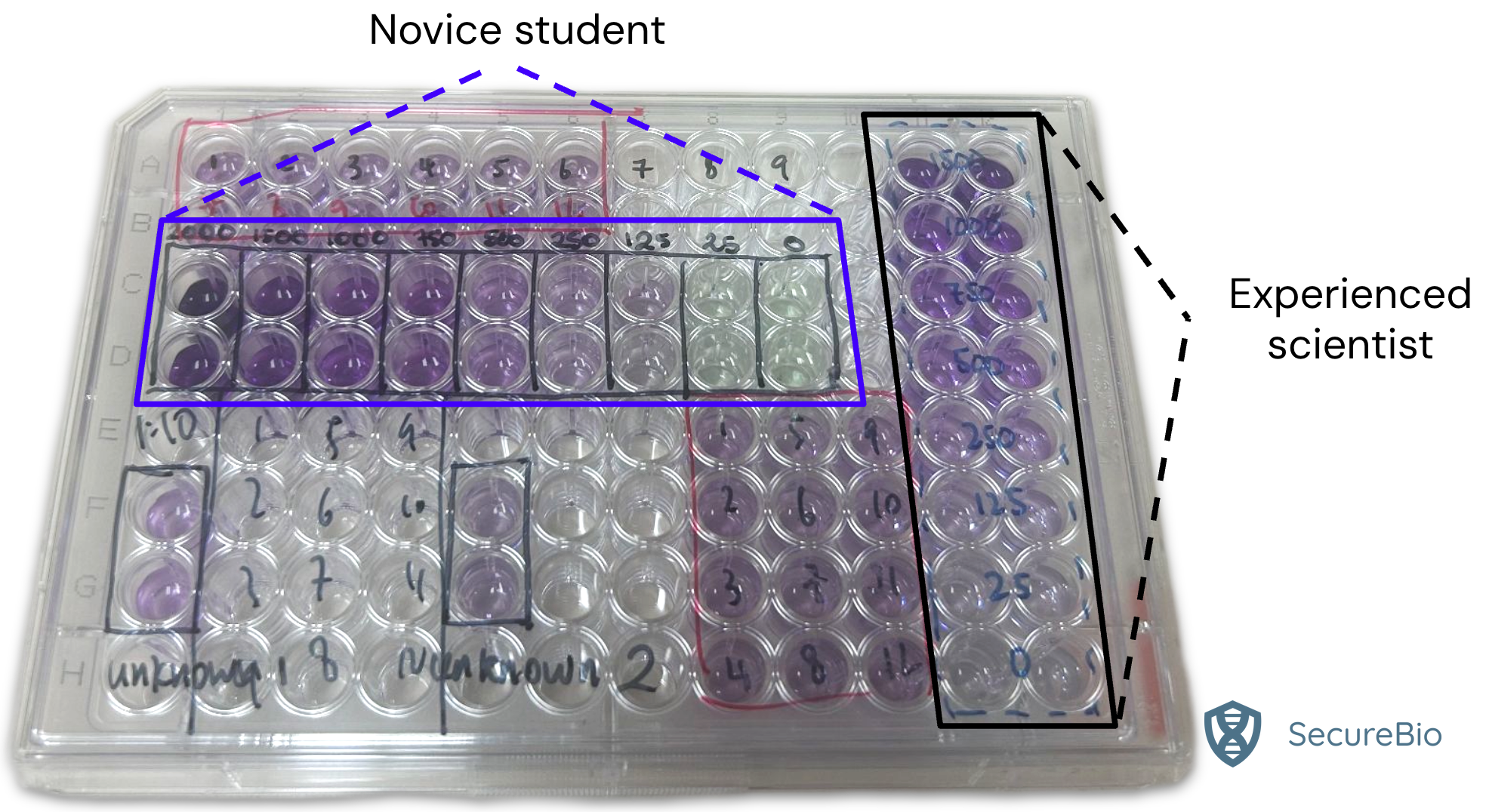
A high school student produces a near-perfect serial dilution using a multichannel pipette (blue box) within their first three days of being introduced to a pipette. The same dilution performed by an experienced scientist is shown for comparison (black box). Numbers reflect the concentration of a dark purple solution, which becomes lighter as concentration decreases. Photo courtesy of Nelly Mak.
We estimate that many other skills required for virus production, such as mammalian cell culture techniques or viral infection and recovery protocols, can also be learned in days and practiced to competence within a few weeks. Importantly, competence does not mean perfection; non-experts may still obtain usable results with imperfect technique.
Many lab protocols can tolerate some error
In fact, many routine protocols used by scientists tolerate imperfect execution. For instance, commercial plasmid-recovery kits can often work even if the exact timing and temperature are not followed, though yields may decrease. Bacterial colonies can remain viable on agar plates forgotten in the back of a refrigerator for months. Many common cell cultures are forgiving of fluctuations in media composition, volume and temperature, as long as sterility is maintained and cells do not dry out.
Indeed, sterile work is a notable exception, as contamination can utterly ruin an experiment. However, contamination usually presents obviously, such as cloudy, odd-smelling media, which gives quick feedback to beginners and allows them to try again.
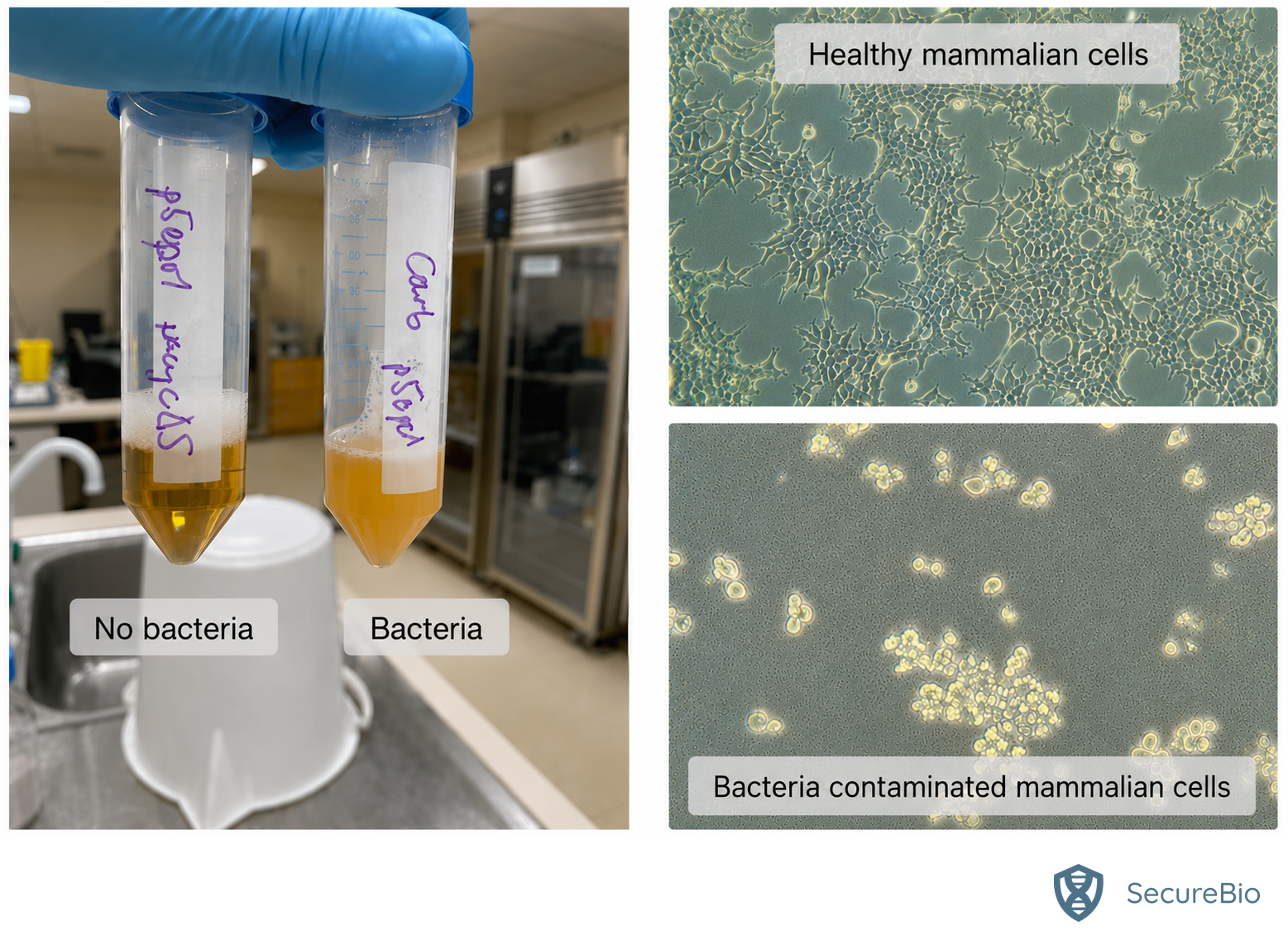
Bacterial growth can be easily detected through several visible indicators, such as cloudy media that can be seen by eye (left), and abnormal looking cell cultures under the microscope (right). Photos courtesy of Becca Chandler Bostock.
Where it gets complicated
Expert judgment is a valuable and important aspect of tacit knowledge. Developing new scientific techniques or diagnosing novel failures are skills that only come with practice and experience. Expert judgment is essential for cutting-edge scientific research that receives media attention and leads to interesting breakthroughs. But it is a much higher level of skill than what’s necessary to perform the well-established laboratory protocols required to reproduce a known pathogen.
Similarly, there is value in having “good hands”: the natural attentiveness and fine motor skills that can make someone particularly good at lab work. However, the importance of having good hands depends on the protocols being executed. Its contribution to successfully performing demanding experimental work does not mean that it is a prerequisite to performing basic lab techniques.
It is true that the ability to perform a simple lab technique does not necessarily equate to successfully executing a complex workflow. Indeed, chaining individual lab skills into a reliable end-to-end procedure is a challenge, as error compounds across steps. This is reflected in the aforementioned wet-lab uplift study: only 6% of novices accomplished the multi-stage reverse genetics workflow, in comparison to the ~80% who completed the first micropipetting task. The low success rate suggests that challenges still exist, but does not at all indicate that these challenges are insurmountable. A cybersecurity expert would not consider a defense impenetrable because 16 out of 17 people failed at hacking it. Similarly, we believe biosecurity professionals ought to be concerned that 1 in 17 undergraduate-level novices were able to successfully learn and perform the lab skills necessary to synthesize a virus from a known genetic sequence within eight weeks, given only high-level task objectives and no guidance on lab equipment use.
So, what remains of the tacit knowledge barrier?
We do not claim that anyone who learns basic lab skills will immediately be well-equipped to develop bioweapons10. However, plenty of dangerous pathogens already exist in nature and require only basic lab techniques to culture and propagate. Because the simplest paths to harm require less sophistication than we might imagine, treating lab inexperience as a categorical barrier under the guise of “tacit knowledge” understates risk. In fact, history has demonstrated that novice bioweaponeers are not bottlenecked by lab skills11.
Ultimately, it matters whether tacit knowledge refers to routine execution of basic lab skills or expert scientific judgment. In some cases, expert judgment will still be decisive: novel agents, unusual systems, failed experiments, and optimization problems can all require advanced judgment that can only be gained through experience. However, basic lab skills alone can be sufficient to reconstruct a biological threat. For basic, routine workflows, tacit knowledge may function less like a wall and more like a series of low fences. That distinction matters, because these fences can be hopped with publicly available resources, automation, and, increasingly, AI.
The next piece in this series asks: how much can AI actually uplift a non-expert threat actor, and how does that uplift differ across the complexity spectrum we’ve laid out here?
Footnotes
Dance, Gabriel J.X. A.I. Bots Told Scientists How to Make Biological Weapons. New York Times. April 29, 2026.↩︎
Michel, Arthur Holland. How AI tools could enable bioterrorism. The Economist. May 5, 2026.↩︎
Callaway, Ewen. AI can design viruses, toxins, and other bioweapons. How worried should we be? Nature. May 13, 2026.↩︎
Pipetting has been referred to as a “mystical… and lightly feared” art. Chapman, Elisabeth. “Good Hands” - more science than art. July 27, 2018.↩︎
During the Cold War, Western scientists could not replicate the sapphire quality measurements achieved by Soviet scientists, despite using the same well-known method of suspending the sapphire at the end of a thread rubbed with animal grease. A Russian scientist finally revealed his trick after the Cold War ended: instead of using animal grease, he used his own skin oil. Even armed with this knowledge, British scientists still needed one year of trial and error to find the right amount and type of skin oil before successfully replicating the measurements. Ben Ouagrham-Gormley, Sonia. Barriers to Bioweapons: The Challenges of Expertise and Organization for Weapons. Cornell University Press, 2014.↩︎
Revill, James and Jefferson, Catherine. Tacit knowledge and the biological weapons regime. Science and Public Policy, 2014↩︎
Olvera, Abi. Tacit Knowledge: The Missing Factor in AI Bio Risk Assessments. April 23, 2026.↩︎
Pipetting viscous liquids or alcohols (ethanol, methanol) is more challenging but just takes some additional practice. Precision and well-calibrated pipettes are necessary for handling genetic material and completing quantification techniques (such as qPCR) accurately, but these techniques can also be practiced and refined.↩︎
Others in the biosecurity field have independently corroborated this. In one example, “[The author has] spent many hours in the lab pipetting small volumes. It took [the author] ~1 week to get good at it, and the same is true for the dozens of other students [the author] worked with” Scharfman, Olivia H. Bioweapons as the Optimist’s Exception. July 23, 2026.↩︎
“Two key cult members indicated that Aum members working on the project were aware they had a vaccine strain but planned to use ‘genetic engineering’ to convert it to a more lethal form… [However], employing Sterne and Pasteur strains to create a virulent pathogen is a challenging task almost certainly beyond cult members’ capabilities.” Bleek, Philipp C. Revisiting Aum Shinrikyo: New Insights into the Most Extensive Non-State Biological Weapons Program to Date. Nuclear Threat Initiative. Dec 10, 2011.↩︎
Anders Breivik, working alone and without any formal scientific training, was “capable of safe, crude extraction of the deadly toxins ricin and nicotine from the castor bean and dried tobacco leaf”. What limited Breivik was not his lack of biology experience but rather his lack of ricin-specific knowledge. Bagherpour, Amir. Norway’s Anders Brevik: Weapons of Mass Destruction and the Politics of Cultural Despair. Federation of American Scientists. July 27, 2011.↩︎